
Detailed explanation of the latest standards of ISO14001:2026 environmental management system
I. Basic information of standards and timeliness of version change
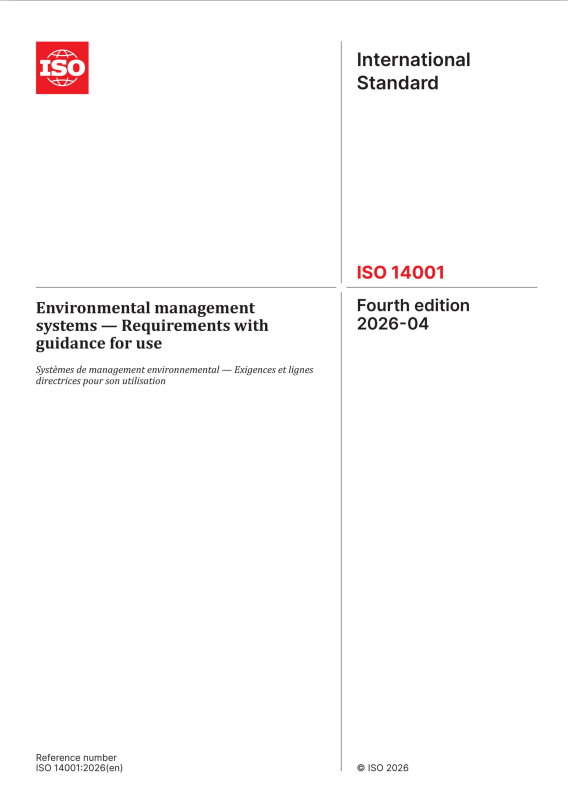
ISO 14001:2026 is the fourth edition of environmental management system standard officially released by the International Organization for Standardization on April 15, 2026. It completely replaces the 11-year-old ISO 14001:2015 version, and is also the only latest and effective environmental management system certification basis in the world. This revision is not a subversive revision, but based on the current situation of the global ecological environment, the upgrading of environmental protection laws and regulations in various countries and the green management needs of enterprises, the original clauses are refined, clarified and strengthened, and the overall high-order structure of ISO is unified, which can be efficiently integrated with ISO 9001, ISO 45001 and other management systems.
According to the unified transition period rules of the International Recognition Forum IAF, the new version of the standard has a compliance conversion cycle of about three years, and the specific time nodes are clear and clear: the new version will officially take effect on April 15, 2026, and enterprises can independently start the system version change and rectification; From July 2026, domestic formal certification bodies will fully carry out the audit and certification of the new version; April 30, 2029 is the final transition period deadline, at which time all ISO 14001:2015 certificates will be uniformly invalid, and from May 1, 2029, only 2026 certificates can be recognized globally.
2.Core logic of this revision
Compared with the 2015 edition, which focuses on basic compliance control, the core change of the 2026 edition is to shift from "process compliance" to "practical implementation and controllable performance". The standard no longer only requires enterprises to establish a sound environmental management system, but emphasizes quantifiable and verifiable environmental improvement results. At the same time, it closely follows the current core issues of global environmental protection, and makes hot requirements such as climate change, biodiversity protection and resource shortage management explicit and mandatory, in line with the United Nations Sustainable Development Goals, and adapts to the market trends of global carbon barriers and green supply chain audit.
In addition, this revision unifies the clause logic of various management systems, streamlines the redundant document requirements, solves the problems of vague expression of some clauses in the old version, no unified standard for enterprise landing, and different calibers of audit and judgment, greatly reduces the management cost of multi-system parallel, and adapts to the implementation of large, medium and small enterprises of all sizes.
3.ISO 14001:2015 Upgrade 2026 Core Substantive Changes
1. Refine the requirements for organizational environmental identification, and add five core environmental issues management and control
The old version of the standard only makes broad requirements for the identification of internal and external environmental factors of enterprises, and has no clear management and control direction. The 2026 edition clearly stipulates that enterprises must fully cover five core environmental issues when identifying environmental factors and risks and opportunities: climate change and greenhouse gas control, biodiversity protection and ecological impact, water shortage and water pollution, soil degradation and land pollution, and air and solid waste treatment.
At the same time, enterprises are required to complete two-way assessment, not only to investigate the negative impact of their own production and operation activities on the surrounding ecology and environment, but also to predict external environmental changes such as extreme weather, resource price increase, tightening of environmental protection policies, and upgrading of carbon emission control, so as to bring business risks and compliance risks to the production and operation of enterprises, and realize dynamic environmental research and judgment.
2. Add key independent clauses: 6.3 Change planning management
This is the core and most practical new content of this revision, and it is also the key deduction point of the new review. In view of the potential environmental hazards caused by various production and management changes of enterprises, the new version sets up separate change planning management and control clauses. Any change behavior that may cause environmental impact needs to carry out risk assessment in advance, formulate control measures, and keep review records.
The coverage scenarios include technical transformation of production lines, equipment renewal, raw material replacement, plant expansion/relocation, production suspension and resumption, replacement of outsourcing service providers, supply chain adjustment, modification of environmental protection systems and emergency procedures, and adaptation of new industry and local regulations. The implementation of this clause can effectively avoid unexpected problems such as excessive sewage discharge, increased solid waste and hazardous waste, and out-of-control environmental risks after technical transformation and process adjustment of enterprises.
3. Standardized separation of risk and opportunity management, more standardized ledger management and control
In the 2015 edition, the contents of environmental risks and opportunities are combined and expressed, and the problems of vague definition and lack of control often occur when enterprises land. The 2026 version establishes 6.1.4 as a separate clause to clearly distinguish negative environmental risks from positive environmental opportunities. Enterprises are required to establish standardized dynamic ledgers, formulate prevention and control measures for each environmental risk, support corresponding landing plans and resource support for environmental opportunities such as energy conservation and consumption reduction, resource recycling, carbon emission reduction and green technological transformation, regularly update and review, and put an end to formal ledger management.
4. Optimize the clause structure and fully align with the new ISO system
In order to meet the management requirements of the integrated system, the new version standardizes and adjusts the structure of the performance evaluation and improvement modules. Among them, the management review clauses are divided into three subdivision modules: general rules, review input and review output, and the review input list is unified, so that the enterprise management review work is based on evidence and avoids empty content. At the same time, simplify the improvement module, merge and optimize the original scattered continuous improvement clauses, simplify the hierarchy, delete redundant standard requirements, and effectively reduce the pressure of enterprise document compilation and system maintenance. In addition, the new version cancels the comparison table of old and new clauses in Appendix B, and further unifies the standard expression caliber.
5. Strengthen senior responsibilities and extend environmental management and control of the whole value chain
The new version further consolidates the main responsibility of the top management for environmental management, and completely changes the situation that the middle and senior management of the old version only authorized the environmental protection commissioner to take full responsibility and neglected to participate themselves. The management is required to deeply participate in the formulation of environmental strategy, allocation of environmental protection resources and annual environmental performance review of the enterprise, assume the ultimate responsibility for the overall environmental compliance and performance results of the enterprise, and at the same time drive all employees to participate in environmental management, covering all positions rather than only management positions.
At the level of operation control, the original "outsourcing process control" was upgraded to the whole chain control of externally provided products, processes and services, and the environmental management requirements were compulsorily extended to upstream and downstream suppliers, subcontractors, logistics service providers and outsourcing units. Enterprises need to establish a supplier-side environmental audit mechanism to verify partners' pollution discharge compliance, solid waste disposal, carbon emissions, green production, etc., so as to achieve environmental risk management and control in the whole supply chain.
6. Unification of terminology, comprehensive upgrade of compliance control and performance evaluation
The new version unifies the professional terminology of the whole standard, replaces vague expressions, eliminates the judgment differences of different certification bodies and auditors, and makes the standard more unified. At the level of compliance obligations, enterprises are required to establish a normalized regulatory investigation mechanism, regularly update new national, local and industry environmental protection regulations and carbon control policies, predict compliance risks in advance, and establish an early warning mechanism.
In the monitoring, measurement and performance evaluation link, completely get rid of the single mode of "only checking pollutant discharge to meet the standard", requiring enterprises to establish quantitative environmental performance indicators, focusing on monitoring improved indicators such as carbon intensity, energy utilization efficiency, water resources consumption, waste recycling rate, pollutant emission reduction, etc., and support the continuous improvement of the system with real and quantifiable performance data.
4.Overall Framework of ISO 14001:2026 Standard
The new edition follows the high-level standard structure of ten chapters as a whole, and the overall framework is stable. Only the internal clause subdivision and content requirements are optimized, and there are no additions or subtractions of chapters: introduction, scope, normative reference documents, terms and definitions, organizational environment, leadership role, planning (including new change planning), support, operation, performance evaluation and improvement. The overall structure is compatible with all kinds of new management systems, which is suitable for enterprises to build an integrated management system.
5.Suggestions on the implementation of the new version of the enterprise
First of all, it is necessary to complete the training for all employees of the new version of the standard, focusing on management, production, procurement, equipment and environmental protection positions, and clarifying the new requirements and audit priorities of the new version. Secondly, a comprehensive self-examination of gaps was carried out, and the missing items of existing systems, ledgers and processes were sorted out according to the new requirements of climate control, biodiversity, change management and supply chain control.
Targeted revision of system documents, new changes in environmental risk management and control procedures, and updates of risk opportunity ledger, supplier environmental management system and management review template. At the same time, we optimized the quantitative environmental targets, supplemented the performance indicators related to carbon emission reduction, resource conservation and ecological protection, and improved the daily monitoring records. Finally, before the end of the transition period in April 2029, the new version of the certificate review and renewal will be completed to ensure the continuous validity of the certificate and avoid compliance risks and supply chain access restrictions.
-
 What is covered on Page 9 of ISO 14001:2026 (en)?
 -
What should be noted on page 7 of ISO 14001:2026 (en)?
-
What is elaborated on page 6 of ISO 14001:2026 (en)?
-
What is included on page 5 of ISO 14001:2026 (en)?
-
What content on page 4 of ISO 14001:2026 (en) do you need to understand?
-
What content is covered on page 3 of ISO 14001:2026 (en)?ISO
Hi, this is a comment.
2026-07-01 3:34 amTo get started with moderating, editing, and deleting comments, please visit the Comments screen in the dashboard.
Commenter avatars come from Gravatar.