
What is included on page 5 of ISO 14001:2026 (en)?
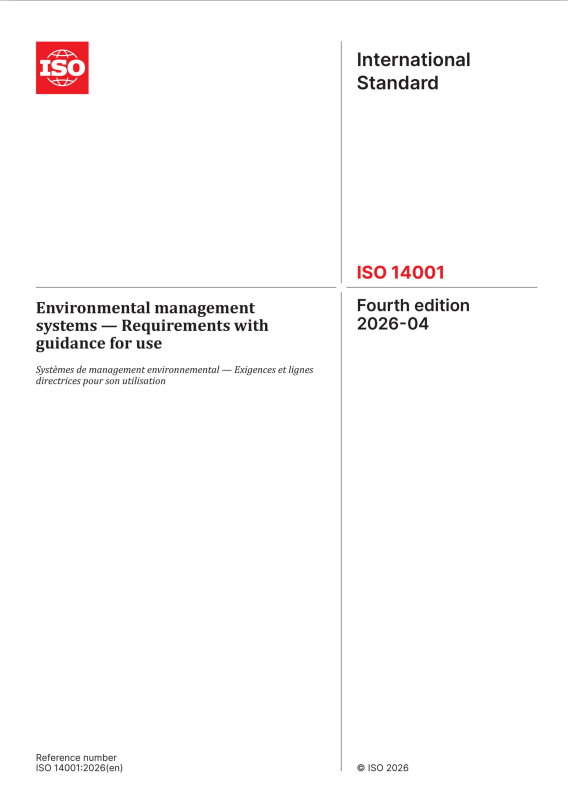
After over a decade guiding factories, service firms and group corporations through ISO 14001 certification and annual surveillance audits, I’ve spotted a consistent, costly mistake across nearly every new environmental management system rollout: teams rush straight to drafting planning documents without fully unpacking the Clause 3.2 planning-related terms laid out on this standard page. This batch of definitions acts as the foundational vocabulary for all work covered in Clause 6 (Planning), and every attached note carries practical audit weight that generic online standard summaries rarely highlight. Misinterpreting even one of these terms leads to incomplete environmental risk assessments, vague target setting and formal non-conformities during third-party evaluations.
We kick off with 3.2.1 environment, a seemingly simple term that most site leaders misdefine at first glance. The official wording frames the environment as all surrounding systems where a business operates, covering air, water, land, natural resources, wildlife, human populations and all their interconnections. The two supplementary notes fix two widespread blind spots for facility environmental teams. Note 1 clarifies the scope of surroundings isn’t limited to factory fences; it stretches from on-site workshop spaces all the way to local watersheds, regional ecosystems and even global environmental systems like cross-border carbon cycles. I’ve audited dozens of manufacturing plants that only tracked on-site waste discharge while ignoring the global environmental footprint of their imported raw material extraction—this oversight directly stems from misunderstanding this definition’s broad boundary. Note 2 adds that environmental surroundings can be measured and categorized via biodiversity levels, ecosystem health, climate trends and other distinct traits, which guides companies to build multi-dimensional baseline environmental records instead of only tracking basic air and water pollutants.
Next, 3.2.2 environmental aspect draws a clear dividing line between organizational activity and environmental change, a distinction countless staff mix up daily. An environmental aspect refers to any element of a firm’s operations, manufactured goods or delivered services that interacts (or could interact) with the environment. Note 1 creates an unbreakable logical chain: environmental aspects generate environmental impacts, and a significant environmental aspect is any element that creates serious negative or positive impacts. A classic audit error I encounter repeatedly is teams labeling wastewater contamination as an environmental aspect, when in reality the act of discharging process water is the aspect, and water pollution is the resulting impact. Note 2 adds a critical compliance rule: each organization must write down formal, consistent criteria to judge which aspects qualify as significant. Sites that pick “significant” aspects based on informal manager opinions without documented evaluation rules always receive minor non-conformities during certification.
3.2.3 environmental condition is a short but underutilized definition that shapes baseline environmental planning. It describes the measurable state of local environmental systems captured at a specific moment in time. In practice, this covers quarterly river water test data, annual local biodiversity surveys, seasonal ambient air quality readings and baseline soil sampling reports. Many small businesses skip collecting documented environmental condition data before mapping their environmental risks, leaving them unable to prove how their operations shift local environmental status over time—a gap auditors consistently flag during Clause 6 planning reviews.
Following that, 3.2.4 environmental impact defines any shift to the surrounding environment triggered (fully or partially) by an organization’s environmental aspects, with a key detail most operators overlook: impacts can be harmful or beneficial. Most site environmental registers only log negative outcomes like waste pollution or resource depletion, while ignoring positive impacts such as on-site native tree planting, rainwater harvesting systems that cut municipal water extraction, or recycled raw material procurement that lowers mining demand. The standard requires full recording of all impacts, both adverse and positive, so one-sided registers fail to meet ISO 14001:2026 planning requirements.
3.2.5 objective lays out the universal framework for all target-setting within an EMS, supported by four detailed notes that resolve confusion around layered business goals. Note 1 separates objectives into three clear tiers: long-term strategic company-wide targets, mid-range tactical departmental goals, and short-term daily operational benchmarks. Note 2 confirms objectives span multiple business disciplines (finance, safety, environment) and can apply to entire corporations or single projects, product lines or production workflows. Note 3 offers flexible phrasing alternatives—terms like aim, goal or target all count as valid objectives, which gives teams flexibility when drafting internal KPI documentation without breaking standard rules. Most vital for EMS users is Note 4, which specifies that environmental objectives under this standard must align with the organization’s official environmental policy, a rule that rules out arbitrary, disconnected environmental targets with no link to senior management’s stated sustainability commitments.
Building directly on that foundation, 3.2.6 environmental objective narrows the broad “objective” definition to sustainability-specific targets, formally tied to the firm’s documented environmental policy. This term becomes the core output of Clause 6 planning; every environmental action plan, resource allocation and performance tracking process revolves around these customized environmental objectives.
The final entry on this page, 3.2.7 prevention of pollution, defines the core proactive sustainability approach required by ISO 14001:2026, paired with a comprehensive note listing actionable implementation methods. The core definition frames pollution prevention as utilizing adjusted workflows, materials, energy sources and services to stop, reduce or control pollutant creation and release to cut harmful environmental impacts. Note 1 breaks down the full spectrum of valid pollution prevention tactics, prioritizing source-level solutions over end-of-line treatment: eliminating waste at its source, reformulating products or production lines, boosting resource efficiency, switching to low-impact substitute materials, reusing materials, recovering and recycling waste, reclaiming resources, and final waste treatment. A pervasive industry misconception I confront constantly is companies relying solely on wastewater or exhaust treatment equipment and claiming they meet pollution prevention rules. Auditors will push back hard on this practice, as the standard prioritizes source reduction over late-stage cleanup, and facilities without front-end pollution avoidance measures will face planning system gaps.
To wrap up, this single page of Clause 3.2 terminology is not just background reference text—it creates the logical backbone for all environmental planning work required by ISO 14001:2026. Every step from identifying local environmental baselines, ranking significant environmental aspects, drafting measurable environmental targets to designing pollution reduction plans relies entirely on consistent, correct interpretation of these seven core terms and their supporting notes. Organizations that skim over these definitions to jump straight into planning documentation almost always create disjointed, non-compliant EMS systems that demand costly rewrites before they can pass official certification audits.
-
 What is covered on Page 9 of ISO 14001:2026 (en)?
 -
What should be noted on page 7 of ISO 14001:2026 (en)?
-
What is elaborated on page 6 of ISO 14001:2026 (en)?
-
What content on page 4 of ISO 14001:2026 (en) do you need to understand?
-
What content is covered on page 3 of ISO 14001:2026 (en)?ISO
-
 What information on page 2 of ISO 14001:2026 (en) do you need to know?
What is included on page 5 of ISO 14001:2026 (en)?: