For anyone who has long worked with environmental management system standards, the preliminary explanatory segments of the newly released ISO 14001:2026 lay out the foundational logic that underpins the entire standard’s implementation logic, covering customizable EMS design rules, the core PDCA iterative model, and unified structural specifications for all ISO management system standards.
First off, the opening paragraph clarifies there is no one-size-fits-all environmental management system. How detailed or complicated an enterprise’s EMS needs to be hinges on multiple unique internal and external factors: the overall operating context of the organization, the defined boundary scope of its environmental management system, all legal and voluntary compliance duties it bears, plus the inherent traits of its daily operations, manufactured goods and service offerings—especially all environmental factors generated by its business and the corresponding pollution, resource consumption and ecological impacts those factors bring. This flexible design principle breaks the old stereotype that all firms must build identical environmental management frameworks, leaving space for tailored deployment for small workshops, large manufacturing groups and service businesses alike.
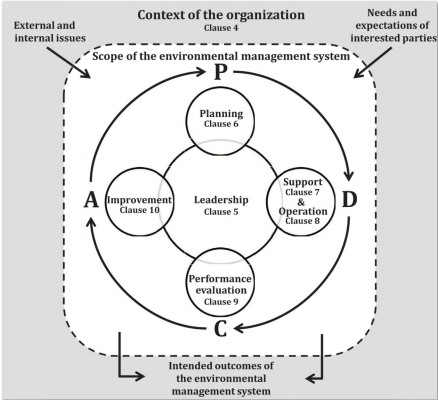
Section 0.4 centers on the Plan-Do-Check-Act cycle, the fundamental logic backbone of the whole environmental management system. Unlike a one-time static workflow, PDCA is a repeatable, looping mechanism built to push sustained environmental performance upgrades, and it works not just for the full EMS framework, but also every single individual component within the system. The standard gives clear simplified definitions for each link of the cycle:
Plan stage means setting targeted environmental goals and designing matched standardized workflows, all aligned with the official environmental policy formulated by the organization itself.
Do stage refers to strictly rolling out all pre-planned environmental control procedures in real daily business activities.
Check stage covers regular tracking, quantitative testing and data comparison against the company’s environmental policy commitments, preset environmental targets and operational control benchmarks, alongside formal collation and submission of all monitoring outcome records.
Act stage stands for rolling out targeted corrective and optimization moves based on checked data, to keep lifting the maturity of environmental management on an ongoing basis.
The attached Figure 1 visualizes the organic connection between the standard’s clause framework and the PDCA cycle, mapping core standard chapters to each cycle phase. Clause 4 covering organizational context (internal/external challenges, stakeholder demands and EMS scope) falls entirely into the Plan module; Clause 5 covering leadership and support links to the Do stage alongside operational control requirements; performance evaluation clauses correspond to Check work, while continuous improvement mechanisms sit under the Act phase. This visual mapping helps both new entry-level auditors and long-term EMS managers quickly grasp why the standard adopts a systematic management mindset, rather than scattered isolated environmental control measures.
Then Section 0.5 explains the unified structural design of ISO 14001:2026. This updated standard fully follows the unified drafting rules set by ISO for all management system standards. It shares a synchronized chapter layout, consistent core normative text, and unified terminology and definition sets with other mainstream ISO standards such as ISO 9001 for quality management. This harmonized design delivers huge practical benefits for organizations running multiple management systems at the same time—enterprises no longer need to maintain separate definition libraries or disjointed document structures for quality, environment and occupational health systems, greatly cutting documentation and audit workloads.
As a preface chapter ahead of formal normative clauses, these pages deliver far more than just basic definitions. They set the core implementation tone for ISO 14001:2026: environmental management is flexible, cyclically iterative, and compatible with integrated multi-system operation, laying the groundwork for all subsequent mandatory compliance requirements in the full standard.

 What should be noted on page 7 of ISO 14001:2026 (en)?
 Insights on the Opening Section of ISO 14001:2026 Official English Version: Core Rationale & Essential Knowledge for EMS Professionals
What information on page 2 of ISO 14001:2026 (en) do you need to know?: